
 EN




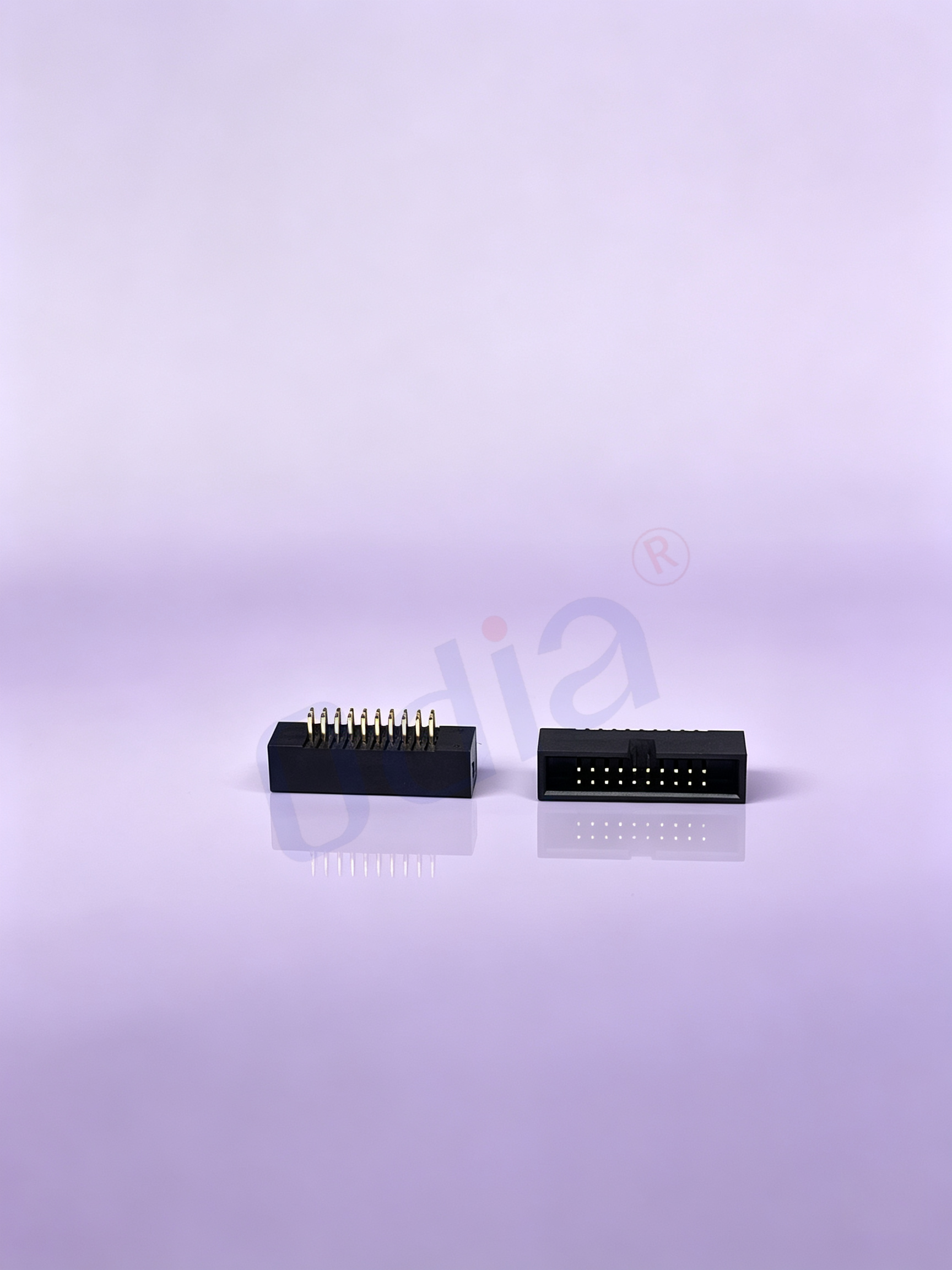
Berg Header/Right-Angle IDC Connector: Category Overview
A Berg Header/Right-Angle IDC Connector combines a PCB-mounted box header with an insulation displacement contact system designed for direct ribbon cable termination. The right-angle configuration routes the ribbon cable horizontally along the PCB surface rather than perpendicular to it, which matters more for enclosure geometry and cable routing constraints than for any electrical performance reason. Choosing between a vertical berg header and a right-angle IDC connector is not simply a board height decision—the real driver is usually whether the enclosure lid, adjacent components, or cable routing path impose a constraint on vertical mating access. Getting this orientation decision right in the layout phase avoids a board revision downstream.
IDC (Insulation Displacement Connector) technology works by pressing a ribbon cable conductor onto a U-shaped blade contact that pierces through the wire insulation and forms a gas-tight cold weld with the conductor—eliminating the need to strip individual wires before assembly. This one-step termination method significantly reduces assembly time and minimizes wiring errors in cable harness production. The Berg Header/Right-Angle IDC Connector product family follows common ribbon cable pitches, with 2.54mm pitch being the most widely used configuration for standard flat ribbon cable interfaces.
Key Product Characteristics
The following characteristics define what to evaluate when selecting a Berg Header/Right-Angle IDC Connector for a specific application:
- Right-angle cable exit orientation: The right-angle design routes ribbon cable horizontally along the PCB plane, optimizing cable management in space-constrained enclosures where vertical cable routing is impractical or creates assembly clearance problems.
- Strip-free IDC termination: The insulation displacement mechanism allows direct ribbon cable attachment without individual wire stripping, reducing both assembly time and operator error rates in cable harness production and field installation.
- Polarization and keying housing options: Shrouded box header designs include polarization ribs or keying features to prevent reversed cable assembly—a practical safeguard in multi-cable industrial control installations where connector housings of similar appearance are installed adjacently.
- Dual-row ribbon cable compatibility: Dual-row IDC connector configurations are designed for compatibility with industry-standard ribbon cable pitches, enabling drop-in integration with existing cable assemblies in system upgrades and retrofit projects.
- Standard footprint compatibility: The product line is designed around standard pitch connector footprints widely used in industrial control and PCB design, which reduces dimensional verification burden when qualifying a new supply source against an existing PCB layout.
- RoHS-compliant materials: Connector materials comply with RoHS requirements, supporting export compliance for buyers whose finished products are sold into the EU and other regulated markets.
- Through-hole and IDC crimp termination: The product family includes both IDC ribbon cable crimp type and through-hole board soldering configurations, covering the full range of board-mount and cable assembly interface requirements.
Common Applications for Berg Header/Right-Angle IDC Connector Products
You already know that IDC ribbon cable interfaces appear broadly across PCB-based electronics. What is worth focusing on is where the right-angle orientation adds specific value—and that is in any assembly where the board sits in an enclosure with limited vertical clearance, or where the ribbon cable needs to exit parallel to the board surface for organized routing within a control cabinet, chassis, or compact device.
In industrial automation, a Berg Header/Right-Angle IDC Connector is commonly specified for PLC I/O modules, sensor interface boards, and data acquisition frontends where flat ribbon cables route signals between PCB assemblies within a control enclosure. In telecommunications infrastructure, these connectors appear in backplane ribbon connections and internal signal distribution assemblies. Embedded electronics designers use them in display interface connections, keyboard matrix ribbon cables, and internal device wiring where connector orientation is constrained by mechanical design. Medical instrumentation panels and test equipment frontends are additional application areas where the compact right-angle cable exit supports clean wire management within tight form-factor enclosures.
In most industrial installations reviewed, the determining factor for long-term connector reliability is not only the component specification but also assembly process consistency. Unlike crimped connectors where contact size tolerates some conductor gauge variation, a Berg Header/Right-Angle IDC Connector requires precise conductor gauge matching—deviating from the specified AWG range by even one gauge can result in incomplete insulation displacement and intermittent electrical contact, a failure mode that is difficult to reproduce during standard incoming inspection.
How to Choose the Right Berg Header/Right-Angle IDC Connector
The primary selection variables for a Berg Header/Right-Angle IDC Connector are pitch, circuit count, housing type, orientation, and conductor gauge compatibility. Here is a practical walkthrough of each decision point based on typical industrial and embedded application requirements.
- Pitch: Match the connector pitch to the ribbon cable pitch. 2.54mm (0.1 inch) is the standard for conventional ribbon cable. Pitch mismatch by one size is one of the most common sourcing errors in this category—confirm both connector pitch and cable pitch before placing an order.
- Circuit count: Select based on signal count requirements. Dual-row configurations double circuit density for a given connector width, which matters in space-constrained board designs where width is the binding constraint.
- Orientation—right-angle vs. vertical: Enclosure geometry typically settles this decision faster than the datasheet does. If the ribbon cable needs to exit parallel to the PCB surface, right-angle is correct. If cable routing is perpendicular to the board plane, a vertical box header is more appropriate.
- Conductor gauge compatibility: Verify the AWG specification of your ribbon cable against the connector's rated range before assembly. Going outside the specified gauge range risks an incomplete IDC termination, producing an intermittent connection that is difficult to diagnose under production test conditions.
- Tooling and assembly process: Standard IDC connectors can be terminated with a bench press or a dedicated IDC hand tool. After field signal errors in some industrial controller installations, root cause traced back not to connector quality but to inconsistent cable alignment during IDC termination—a reminder that connector reliability is a joint outcome of component specification and assembly process control. Where field technicians are performing terminations, select a housing with alignment guides and verify operator training.
- Shrouded vs. unshrouded housing: Shrouded headers with polarization ribs provide assembly error-proofing and are the preferred choice for field assembly or harness production environments. Unshrouded berg headers offer cost and footprint advantages where process controls are sufficient to prevent orientation errors.
What this means in practice: specifying a polarized shrouded Berg Header/Right-Angle IDC Connector for harnesses assembled by field technicians typically returns value through reduced rework cost and lower field error rates, even when the unit price is marginally higher than an unshrouded alternative.
Why This Category Matters for Industrial Procurement
Industrial automation buyers prioritize connector reliability above unit price for equipment operating continuously with limited maintenance windows—because a field failure caused by a faulty Berg Header/Right-Angle IDC Connector in an automated production line or data acquisition system can cost multiples of the connector's annual procurement value in downtime, investigation, and corrective action. The connector market for IDC and box headers is highly fragmented, with hundreds of manufacturers offering overlapping product ranges, which makes differentiating on technical depth and application-specific guidance more meaningful than catalog comparisons alone for buyers qualifying a new supply source.
For buyers sourcing a Berg Header/Right-Angle IDC Connector for industrial control and data acquisition applications, the product line available here is designed to cover the most common ribbon cable pitches and circuit counts used in these environments. Standard pitch footprint compatibility reduces the dimensional verification burden when qualifying an alternative supply source against an existing PCB layout—particularly relevant in production environments where any board revision triggers a re-validation cycle.
If you are evaluating this category for a new design or qualifying an alternative supply source, request samples to verify pitch, circuit count, housing dimensions, and cable gauge compatibility against your assembly requirements before committing to a production order. Pre-sales technical support is available to assist with selection based on application requirements, operating environment, and system integration constraints specific to your project.